So while I'm working on my various summer short fiction projects, I've been doing a lot more thinking about traditional publishing and submitting stories to the few markets that pay very well.
Really, there aren't very many.
I've also been reading more of them. I work my way through a story every morning at breakfast now, and it's been a fantastic addition to my day. I've also learned that there are an awful lot of very good writers creating very good short fiction out there, and that many of them have never published a novel.
And because let's go ahead and form a trifecta so we can triangulate my thoughts, I've also been thinking more about writing fiction for a living and how simultaneously terrifying, liberating, and exhilarating it must be.
These three things have come together and forced me to ask myself a new question every time I write a story. They have also shed some light on why traditionally published authors can be so darn hostile sometimes.
The question is this: Is what I'm writing so good that it deserves to take bread off someone's table and put it on mine instead?
Because that's an undeniable reality. Clarkesworld, Tor.com, Asimov's, Lightspeed, Apex, et al. only publish a few stories each every month. Depending on the particulars of a story (length, especially), the markets for it might be even more limited. There really isn't that much money to go around (and for the record, it's better in SFF than it is in other genres), and if some of it goes to me, it's not going to someone else. Someone else who's probably writing something great, and who may be depending on the sales of their short fiction to stay afloat.
I won't feel bad about that, but only if I'm writing something that's so damn good that when they read it, they'll agree with the editor for buying it.
This isn't to say that you shouldn't write and shouldn't seek markets for your writing once you've finished it. But it's a piece of the puzzle that I had forgotten about, and it's worth remaining conscious of.
Cheers, and Happy Monday,
Jeff
Showing posts with label authors. Show all posts
Showing posts with label authors. Show all posts
Monday, June 16, 2014


Monday, May 12, 2014
Industry Norms: Buying Other Authors' Books
This weekend I did a book signing at Robots & Rogues in Lafayette, IN, during a larger event called the Mosey Down Main Street. It was awesome. On top of selling a bunch of books, I met a bunch of great people, including several local authors. I got to hang out and talk fantasy and science fiction for hours on a Saturday night as well, which is one of my favorite things to do in the world.
When the bookstore and I settled up afterward, I had made some money. I gave about half of it back by buying the books of authors I'd met that night, or who were going to be coming by the store later in the summer and whose books I wanted to read beforehand.
This is an industry norm, and it's one I didn't learn about until last year, and it's one that caught me by surprise.
So I thought I'd write about it here, because I now know that there are other writers early in their careers who read this blog, and I feel guilty about not knowing about this norm at the first signing I did and failing to reciprocate when some really friendly authors bought my book there.
It makes sense on many levels, when you think about it. One, it's professional courtesy. But beyond that, it's the best way to make connections with your peers, and believe me, connections with your peers are exceptionally, superlatively important. During one of the signing's quieter moments, I overheard people talking about how "It's really all in who you know." I'm not sure whether they were talking about publishing or not (because a lot of industries work that way), but they could have been.
And the way you get to know people in this industry is by reading their books and reaching out to them. I've made many mistakes in my career (already!), and one of the biggest was in waiting to read the books of other indie authors until I was almost ready to publish Soulwoven. I should have been doing it for a year ahead of time, both so that I knew the market better and so that I could find the ones I liked and tell them how much I liked them. Because that's really important to do as an author. We all live in a world of deep, dark fears and years of trauma during which we learned to write primarily by being told everything that's wrong with how we write. Peer recognition is important---it's a human thing.
So read other authors, especially those you meet in person and who buy your books. Then if you like their book, reach out and tell them so.
I think my initial resistance to doing that was that it felt too much like a pyramid scheme. "What do you mean I have to read a dozen other authors before I publish my book? That sounds fishy..." And when you put it that way, it is fishy.
But you wouldn't launch a restaurant without trying out some of the other ones in the neighborhood, right? And you wouldn't launch a website without seeing who else was doing the same thing and how, right? It's the same here. Reading other authors, in addition to being professional courtesy, is market research. It's important. You should do it. You'll be glad you did.
When the bookstore and I settled up afterward, I had made some money. I gave about half of it back by buying the books of authors I'd met that night, or who were going to be coming by the store later in the summer and whose books I wanted to read beforehand.
This is an industry norm, and it's one I didn't learn about until last year, and it's one that caught me by surprise.
So I thought I'd write about it here, because I now know that there are other writers early in their careers who read this blog, and I feel guilty about not knowing about this norm at the first signing I did and failing to reciprocate when some really friendly authors bought my book there.
It makes sense on many levels, when you think about it. One, it's professional courtesy. But beyond that, it's the best way to make connections with your peers, and believe me, connections with your peers are exceptionally, superlatively important. During one of the signing's quieter moments, I overheard people talking about how "It's really all in who you know." I'm not sure whether they were talking about publishing or not (because a lot of industries work that way), but they could have been.
And the way you get to know people in this industry is by reading their books and reaching out to them. I've made many mistakes in my career (already!), and one of the biggest was in waiting to read the books of other indie authors until I was almost ready to publish Soulwoven. I should have been doing it for a year ahead of time, both so that I knew the market better and so that I could find the ones I liked and tell them how much I liked them. Because that's really important to do as an author. We all live in a world of deep, dark fears and years of trauma during which we learned to write primarily by being told everything that's wrong with how we write. Peer recognition is important---it's a human thing.
So read other authors, especially those you meet in person and who buy your books. Then if you like their book, reach out and tell them so.
I think my initial resistance to doing that was that it felt too much like a pyramid scheme. "What do you mean I have to read a dozen other authors before I publish my book? That sounds fishy..." And when you put it that way, it is fishy.
But you wouldn't launch a restaurant without trying out some of the other ones in the neighborhood, right? And you wouldn't launch a website without seeing who else was doing the same thing and how, right? It's the same here. Reading other authors, in addition to being professional courtesy, is market research. It's important. You should do it. You'll be glad you did.
Friday, May 2, 2014
Some Thoughts on Reviews from Neil Clarke
FIRST! Because I almost forgot and This Is Important: Three Dances will be free to download from Amazon.com starting tomorrow and running through Sunday. If you enjoyed Soulwoven, drop on by and give it a read. It's short and interesting.
SECOND! The meat of this blog post:
Neil Clarke runs an award-winning online science fiction and fantasy magazine called Clarkesworld. The magazine itself is one of my favorites, and as I was thumbing through it last weekend (I get a print copy every month in return for backing them as a patron), I came across a note from him that had to do, in part, with leaving reviews.
You can read it here.
It felt highly relevant to me and to Soulwoven, and since he explains not only the usefulness of leaving a review for your favorite anything (books, yes, but also magazines, restaurants, blenders, dish soaps, and cat leashes), but his own hangups about leaving reviews and how he's going to make an effort to review things anyway, I wanted to share.
It also got me thinking, because I live in a world of publishing where everybody knows that customer reviews are massively important, so much so that we don't even talk about why, and I'm sometimes surprised when I talk to the overwhelming majority of the world that doesn't work in publishing and they don't share my assumptions.
So I'll put it like this:
In the world of Internet commerce, customer reviews are the currency of credibility.
You can thank me for the alliteration later. I took poetry classes in college for that (well, not really for that, but I do love alliteration).
When books come in paper and we go to stores to buy them, we as readers tend to rely on several things to establish their credibility (i.e. whether we think they'll be any good) before we even open them, above and beyond the obvious like whether we've read the author's books before:
1.) Placement in the store. If a store put a book out front, somebody at the store thought it was good enough to highlight.
2.) Who published it. When I pick up a book from a publishing imprint whose name and logo I recognize, I have faith that it will meet a certain editorial standard and contain content of a certain kind.
3.) Physical cues. How's the cover look? Is the paper nice? Does it have a good heft? Does it smell like a book is supposed to smell?
4.) Laudatory quotes from booksellers, review sources, etc.
Internet retailers have done their best to replicate some of those things, but by and large, customer reviews have taken the place of most of them. If 400 people have taken the time to review a book, and the average rating they gave it was 4 stars, we feel reasonably certain that, even if it doesn't end up being right for us, it's at least a decent book in general. If 40 people have done so, we think it's got a niche audience and hopefully it's all right. If four people have reviewed it, it's a bit risky. How do we know it's any good? Who were those four people? Also, who wants to read a book that they can only talk about with four other people? That's boring. I want a book I can talk about with 4,000 of my friends, like this one over here that has prominent placement in the online storefront.
And then the author of the four-review book, who's probably new, who may or may not have the backing of a publishing house (I've seen traditionally published books launch with only a handful of reviews as well), and who might have written something brilliant, never gets read, and everybody loses.
So if you like a book, leave a review for it online, even if that just means clicking the stars. Amazon is the best place to do so, but other retailer sites and Goodreads are great too. That way other people will read it too, and someday you'll have more than just those four other star-givers to talk to about it.
Besides, reviewing is fun. It makes you feel important, which is good, because you ARE important.
Cheers, and happy weekend,
Jeff
SECOND! The meat of this blog post:
Neil Clarke runs an award-winning online science fiction and fantasy magazine called Clarkesworld. The magazine itself is one of my favorites, and as I was thumbing through it last weekend (I get a print copy every month in return for backing them as a patron), I came across a note from him that had to do, in part, with leaving reviews.
You can read it here.
It felt highly relevant to me and to Soulwoven, and since he explains not only the usefulness of leaving a review for your favorite anything (books, yes, but also magazines, restaurants, blenders, dish soaps, and cat leashes), but his own hangups about leaving reviews and how he's going to make an effort to review things anyway, I wanted to share.
It also got me thinking, because I live in a world of publishing where everybody knows that customer reviews are massively important, so much so that we don't even talk about why, and I'm sometimes surprised when I talk to the overwhelming majority of the world that doesn't work in publishing and they don't share my assumptions.
So I'll put it like this:
In the world of Internet commerce, customer reviews are the currency of credibility.
You can thank me for the alliteration later. I took poetry classes in college for that (well, not really for that, but I do love alliteration).
When books come in paper and we go to stores to buy them, we as readers tend to rely on several things to establish their credibility (i.e. whether we think they'll be any good) before we even open them, above and beyond the obvious like whether we've read the author's books before:
1.) Placement in the store. If a store put a book out front, somebody at the store thought it was good enough to highlight.
2.) Who published it. When I pick up a book from a publishing imprint whose name and logo I recognize, I have faith that it will meet a certain editorial standard and contain content of a certain kind.
3.) Physical cues. How's the cover look? Is the paper nice? Does it have a good heft? Does it smell like a book is supposed to smell?
4.) Laudatory quotes from booksellers, review sources, etc.
Internet retailers have done their best to replicate some of those things, but by and large, customer reviews have taken the place of most of them. If 400 people have taken the time to review a book, and the average rating they gave it was 4 stars, we feel reasonably certain that, even if it doesn't end up being right for us, it's at least a decent book in general. If 40 people have done so, we think it's got a niche audience and hopefully it's all right. If four people have reviewed it, it's a bit risky. How do we know it's any good? Who were those four people? Also, who wants to read a book that they can only talk about with four other people? That's boring. I want a book I can talk about with 4,000 of my friends, like this one over here that has prominent placement in the online storefront.
And then the author of the four-review book, who's probably new, who may or may not have the backing of a publishing house (I've seen traditionally published books launch with only a handful of reviews as well), and who might have written something brilliant, never gets read, and everybody loses.
So if you like a book, leave a review for it online, even if that just means clicking the stars. Amazon is the best place to do so, but other retailer sites and Goodreads are great too. That way other people will read it too, and someday you'll have more than just those four other star-givers to talk to about it.
Besides, reviewing is fun. It makes you feel important, which is good, because you ARE important.
Cheers, and happy weekend,
Jeff
Monday, April 21, 2014
Backstory
This is a very scattered blog post. Because the "log" part of "blog" comes from a time when blogs were more or less public, online substitutes for journals, and sometimes I like to use mine that way still.
Backstory is a very interesting thing. In case you're unfamiliar with the term, it's the part of the book that explains the things that happened before it. Like in The Lord of the Rings when Gandalf tells Frodo about the Ring. It's a very old thing; the Greeks used to do it with choruses of singing people in plays.
When you learn how to write, particularly if you write fantasy or science fiction, one of the first things people are likely to tell you to do is to cut out extraneous backstory. Done poorly, it bogs down a narrative and confuses readers. This is especially true if it's not immediately relevant and triple-dog-dare true if the reader isn't sure who and what the story is about yet.
But a lot of authors use backstory pretty intensively nonetheless. I'm reading Among Others by Jo Walton for my local SF/F indie store's book club, and I just finished a whole long passage of backstory. I've noticed others in Neil Gaiman (American Gods) and Scott Lynch (Lies of Locke Lamora) recently as well. I've noticed it in a whole lot of other authors too, but I can't remember whom or in what books precisely.
And it has occurred to me that when backstory is done right, you can get away with an awful lot of it.
The trick is to focus on the story part of the word.
When backstory works best, it's structured as a little miniature story within the story, almost like flash fiction. It has a beginning and a middle and an end. There's an important event that starts it and an important event that finishes it. The people or things being discussed change in the middle in interesting ways. And ideally it tells you something about characters you already know about and has some kind of impact on the plot.
Of further note: once you've demonstrated that when you use backstory it has an impact on the plot once, readers will trust that anytime you use it from that point on it will become important later, unless you betray them.
Y'know, in case you were curious.
Backstory is a very interesting thing. In case you're unfamiliar with the term, it's the part of the book that explains the things that happened before it. Like in The Lord of the Rings when Gandalf tells Frodo about the Ring. It's a very old thing; the Greeks used to do it with choruses of singing people in plays.
When you learn how to write, particularly if you write fantasy or science fiction, one of the first things people are likely to tell you to do is to cut out extraneous backstory. Done poorly, it bogs down a narrative and confuses readers. This is especially true if it's not immediately relevant and triple-dog-dare true if the reader isn't sure who and what the story is about yet.
But a lot of authors use backstory pretty intensively nonetheless. I'm reading Among Others by Jo Walton for my local SF/F indie store's book club, and I just finished a whole long passage of backstory. I've noticed others in Neil Gaiman (American Gods) and Scott Lynch (Lies of Locke Lamora) recently as well. I've noticed it in a whole lot of other authors too, but I can't remember whom or in what books precisely.
And it has occurred to me that when backstory is done right, you can get away with an awful lot of it.
The trick is to focus on the story part of the word.
When backstory works best, it's structured as a little miniature story within the story, almost like flash fiction. It has a beginning and a middle and an end. There's an important event that starts it and an important event that finishes it. The people or things being discussed change in the middle in interesting ways. And ideally it tells you something about characters you already know about and has some kind of impact on the plot.
Of further note: once you've demonstrated that when you use backstory it has an impact on the plot once, readers will trust that anytime you use it from that point on it will become important later, unless you betray them.
Y'know, in case you were curious.
Sunday, July 28, 2013
Why I'm Doing the Kickstarter
Hello all!
Since I announced the Kickstarter, I've been fielding questions about it from friends, family, fans, and other writers. The biggest (what is it?) I hope I addressed in my last post. But the question I receive next most often is "Why are you doing this?"
So I've been mulling over the best way to communicate that. And then yesterday I got a message on Wattpad from a reader named Sarbjot, in response to a "Hey, thanks for reading!" I'd sent to him months ago. I got his permission to share it with the world, and it reads:
This is what Kickstarter looks like. This is what indie art, these days, looks like. The world is full of people like Sarbjot, who just want to be a part of making a book, a musician, an author, or an artist successful.
Soulwoven is a project for that tribe. If I sent it out to publishers, it would fall into a great sea of fantasy books that are "good but tough to market" and drown there.
But through Kickstarter, I can give all the people who believe in Soulwoven, believe in my writing, and believe in me a chance to stand up and be counted. And when people do that, other people notice, and so on and so on until a book reaches as many people as it can.
I am nervously awaiting the video for my Kickstarter and wondering if I'm going to have to call Kickstarter HQ in a panic to try to get my project's review expedited. In the meantime, I'm making revision notes on the book. The next time you see it, it's going to be tighter, more polished, and ready for widespread consumption, and I think you're really going to love it.
Thanks for believing,
Jeff
Since I announced the Kickstarter, I've been fielding questions about it from friends, family, fans, and other writers. The biggest (what is it?) I hope I addressed in my last post. But the question I receive next most often is "Why are you doing this?"
So I've been mulling over the best way to communicate that. And then yesterday I got a message on Wattpad from a reader named Sarbjot, in response to a "Hey, thanks for reading!" I'd sent to him months ago. I got his permission to share it with the world, and it reads:
@realjeffseymour I'm not sure if I replied to this yet but I've read it before :), I will go back through and site on all the chapters that I liked I might have missed; and I would fan you as an author anytime, you have amazing writing skills and an very intriguing book to boot; which is why I will donate 30$ for the kickstarter, I don't want anything; honestly, I just want to see this book go public and want to see you make it in the writing industry! Have a good one! See you next book :)
This is what Kickstarter looks like. This is what indie art, these days, looks like. The world is full of people like Sarbjot, who just want to be a part of making a book, a musician, an author, or an artist successful.
Soulwoven is a project for that tribe. If I sent it out to publishers, it would fall into a great sea of fantasy books that are "good but tough to market" and drown there.
But through Kickstarter, I can give all the people who believe in Soulwoven, believe in my writing, and believe in me a chance to stand up and be counted. And when people do that, other people notice, and so on and so on until a book reaches as many people as it can.
I am nervously awaiting the video for my Kickstarter and wondering if I'm going to have to call Kickstarter HQ in a panic to try to get my project's review expedited. In the meantime, I'm making revision notes on the book. The next time you see it, it's going to be tighter, more polished, and ready for widespread consumption, and I think you're really going to love it.
Thanks for believing,
Jeff
Friday, May 31, 2013
News for the Week of 5/31/13: Lateness and LOTS OF THINGS
Dear Friends and Readers,
Waagh! Sorry for the late update. Things have been a little
crazy.
First, Soulwoven: Plans for the Kickstarter are coming along
nicely. I’ve got a developmental and line editor in place (Rose Fox, who has an
amazing eye and runs the speculative fiction reviews for Publisher’s Weekly---I
have learned a lot from her just by reading her blog), and I’ve figured out the
copy editor I want to work with as well. I just need to get in touch with him.
I’ve also got a local company (F Stop Productions in Denver) lined up to do a
killer video for it.
The survey to help design it is still open,
and I could use more responses. Those of you who have responded already are
awesome and I love you.
Second, Nadya: I’m working my way through final revisions
now, and it’ll be out on submission by the end of next month barring any major
setbacks. I’m very excited about it---it has love and loss and jokes and
airships and fire spirits and science and lots of other fun things.
Third, Other Stuff: I had a very productive meeting with an
agent last week when I should have been writing this update instead. We talked
about a lot of things, but perhaps the most important is a collaborative
project I want to do on Halloween this year. It’s going to involve a bunch of
writers (pros and semipros and amateurs alike) staying up all night writing
scary stories and Twittering, and it’s going to be awesome. More on that to
come.
So that’s May in the life of Jeff. Hope your spring has
sprung in a most lovely way.
-Jeff
Wednesday, April 17, 2013
Three Dances Launch Party Speechifying, Part Two: Thank You
Just another short clip from the Three Dances launch party speech. A lot of the speech was taken up with thanking people who helped specifically on the book, but I spent a minute or so talking about the ways in which people have helped me generally, sometimes without even realizing it.
And I wanted to share that bit with people who weren't there, because I think sometimes we have a tendency to tell ourselves that people don't want or need our encouragement. And a lot of times that's simply not true.
Enjoy!
And I wanted to share that bit with people who weren't there, because I think sometimes we have a tendency to tell ourselves that people don't want or need our encouragement. And a lot of times that's simply not true.
Enjoy!
Tuesday, April 16, 2013
Expanding on My Three Dances Speech: Traditional Publishers and Hybrid Authoring
Yesterday I posted a link to the first few minutes of the speech I gave at the launch party for Three Dances. In it, I talk about some of the ways in which traditional publishing and self-publishing aren't really that different.
It has occurred to me that this could be misconstrued as me saying that traditional publishing doesn't bring anything to the table. Being as I work in the industry, I want to be clear that I don't think that's the case. Three Dances was a great fit for self-publishing, because it was a project that was niche enough that it would hold little attraction to a traditional publisher no matter how good it was, and it was short and small enough that I could feasibly do all the work on my own. That's not going to be the case for all books or all authors (I have spent years of my life learning the editorial skills I put to work here).
And on top of the advance you might get through a traditional publisher, you get a pretty sweet basket of services thrown in as part of the deal. Top-notch editing, design, and production services for a novel-sized book can pretty quickly run into the thousands of dollars on the freelance market. Marketing and pr, even skimpy as it can be, adds to the cost of a book as well. I used to think thousands of dollars was too much to pay for that kind of work. Now that I make my living as a freelancer, I've realized that if you want skilled labor, you have to pay for it (indie authors may recognize this argument as one they've been making to publishers for years). As much as I owe my authors, I owe my family more.
I do think that indie writers, if they've written a good book, will make their money back over time. But not everybody has that kind of scratch to invest. I sure don't. More importantly, not everybody is a good judge of which projects to make that kind of investment on. I could have spent that money on Three Dances, but it would have taken years to make it back, even if I wildly exceeded my expectations for the sales of the book.
There are several reasons I'm pursuing a traditional deal for Nadya. One of the biggest is that the middle grade market is still very much dependent on bookstore, book club, and library placement, and those are very hard markets for an indie to break into. But the other big one is that I'm willing to sacrifice long-tail money on that book for the services I can get from a traditional publisher, and for the things I could learn from working with one.
I see more and more hybrid authors doing the same thing in my submissions pile at Carina, and I'm always happy to see them, both for their sake and for mine.
--
You can buy Three Dances as a print or e-book on Amazon or Barnes & Noble.
It has occurred to me that this could be misconstrued as me saying that traditional publishing doesn't bring anything to the table. Being as I work in the industry, I want to be clear that I don't think that's the case. Three Dances was a great fit for self-publishing, because it was a project that was niche enough that it would hold little attraction to a traditional publisher no matter how good it was, and it was short and small enough that I could feasibly do all the work on my own. That's not going to be the case for all books or all authors (I have spent years of my life learning the editorial skills I put to work here).
And on top of the advance you might get through a traditional publisher, you get a pretty sweet basket of services thrown in as part of the deal. Top-notch editing, design, and production services for a novel-sized book can pretty quickly run into the thousands of dollars on the freelance market. Marketing and pr, even skimpy as it can be, adds to the cost of a book as well. I used to think thousands of dollars was too much to pay for that kind of work. Now that I make my living as a freelancer, I've realized that if you want skilled labor, you have to pay for it (indie authors may recognize this argument as one they've been making to publishers for years). As much as I owe my authors, I owe my family more.
I do think that indie writers, if they've written a good book, will make their money back over time. But not everybody has that kind of scratch to invest. I sure don't. More importantly, not everybody is a good judge of which projects to make that kind of investment on. I could have spent that money on Three Dances, but it would have taken years to make it back, even if I wildly exceeded my expectations for the sales of the book.
There are several reasons I'm pursuing a traditional deal for Nadya. One of the biggest is that the middle grade market is still very much dependent on bookstore, book club, and library placement, and those are very hard markets for an indie to break into. But the other big one is that I'm willing to sacrifice long-tail money on that book for the services I can get from a traditional publisher, and for the things I could learn from working with one.
I see more and more hybrid authors doing the same thing in my submissions pile at Carina, and I'm always happy to see them, both for their sake and for mine.
--
You can buy Three Dances as a print or e-book on Amazon or Barnes & Noble.
Monday, April 15, 2013
Three Dances Launch Party, Speechifying Part One: How Books Start Their Lives
Hello gentle readers!
The Three Dances launch party farfnoogled its way into history this weekend, to my very great enjoyment, to my stomach's very very great enjoyment, and to my waistline's subtle detriment.
I wish I could offer you a sliver of all the food and conversation, but that is somewhat beyond me.
Instead, I'm going to offer you a snippet of my speechifying. I'll be putting up three clips from it this week, one of which is a reading from the first story in the collection, "The Jazz Festival."
But today's clip touches on something different: how books start their lives, and how in some ways self-publishing and traditional publishing are very much the same.
I'll expound at greater length on some things that didn't fit into the speech tomorrow, but for today, here you go:
As a reminder, you can buy Three Dances in print or e-book on Amazon or B&N.
The Three Dances launch party farfnoogled its way into history this weekend, to my very great enjoyment, to my stomach's very very great enjoyment, and to my waistline's subtle detriment.
I wish I could offer you a sliver of all the food and conversation, but that is somewhat beyond me.
Instead, I'm going to offer you a snippet of my speechifying. I'll be putting up three clips from it this week, one of which is a reading from the first story in the collection, "The Jazz Festival."
But today's clip touches on something different: how books start their lives, and how in some ways self-publishing and traditional publishing are very much the same.
I'll expound at greater length on some things that didn't fit into the speech tomorrow, but for today, here you go:
As a reminder, you can buy Three Dances in print or e-book on Amazon or B&N.
Saturday, February 23, 2013
Some Thoughts on Publishing and Rejection
Today as I was doing first page critiques on Wattpad, I ran across a message from a follower of mine asking how I deal with the constant threat and reality of rejection as a writer. My response to her got a bit longer than the standard e-mail, and I think it's got some points that other people will find interesting as well, so I'm going to share it here.
My response below. Thanks to @fairyfree on Wattpad for the question. :-)
For me, that's harder to deal with than rejection. Rejection can happen for so, so many more reasons than bad writing. It can be because a publisher already has too many books like the one you're submitting, or because the editor dislikes something about your writing that another editor might love, or simply because they were tired and grumpy and not in a mood to cut you any slack when they were reading your submission.
Publishing is an incredibly subjective business. Every piece of writing has an audience, and just because something isn't likely to be commercially successful (Soulwoven, for instance), doesn't mean it's not good. But publishers are businesses, and they can't afford to acquire things they don't think will be commercially successful, so not everything gets acquired.
So don't despair over rejection. It doesn't necessarily mean that you're a bad writer or that you're doing anything wrong (though I certainly had bad novels of mine rightfully rejected early in my career). In the end, if you're writing books that you're proud of, you're winning, period. Readers are a remarkably varied and forgiving group of people, and if you love your work, someone else out there will too, even if it's not a publisher.
Happy Saturday, folks. Everyone is out of town today, so I'm working through the weekend. Wish me luck. :-)
Thursday, May 31, 2012
For the Locker: Dr. Seuss
After a morning news-a-thon filled mostly with reading retrospectives about Maurice Sendak, I came across this post from an amazing site called Letters of Note that may become part of my daily reading. I am amazed at how very modern 1957 Seuss sounds in his advice and how very pertinent it still seems.
I have often thought that if I find success as an author, I shall get a P.O. box and put its address somewhere online or in my author bios and that I shall endeavor to respond to every handwritten letter that comes to me.
Maybe that's naive and romantic, but I still think it's an ideal worth striving towards.
Hopefully Letters of Note won't mind me reposting their images. Their website is silent on the issue.
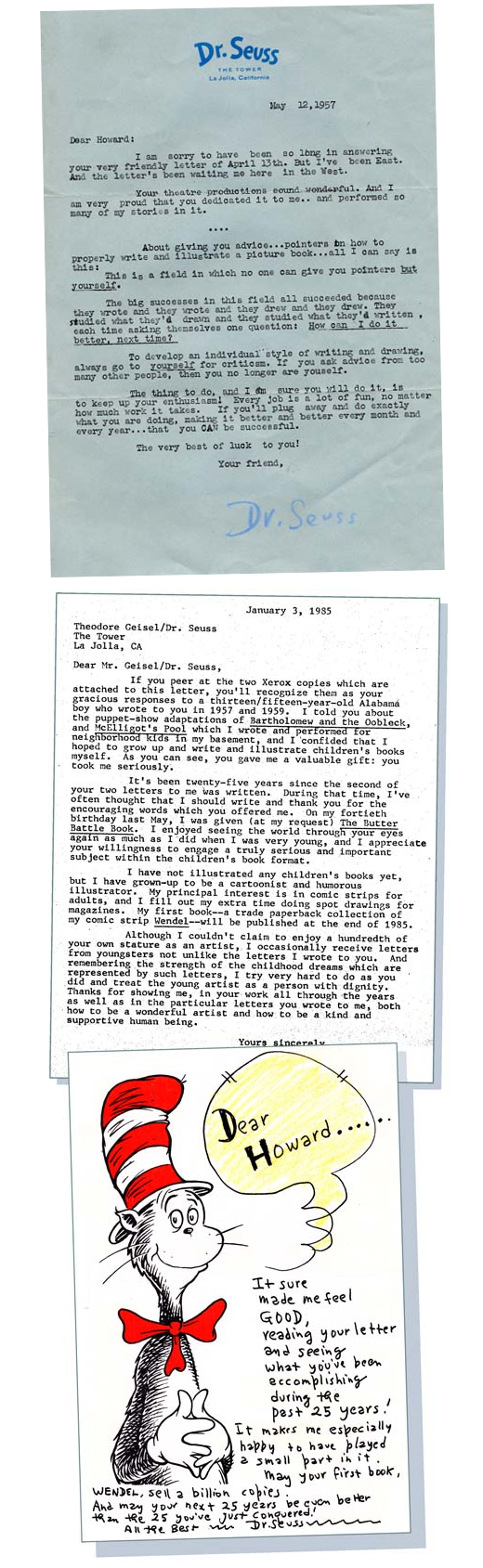
I have often thought that if I find success as an author, I shall get a P.O. box and put its address somewhere online or in my author bios and that I shall endeavor to respond to every handwritten letter that comes to me.
Maybe that's naive and romantic, but I still think it's an ideal worth striving towards.
Hopefully Letters of Note won't mind me reposting their images. Their website is silent on the issue.
Tuesday, April 10, 2012
Authors are Amazing
I finished going through my first set of submissions yesterday, and as I pushed away from the other side of the desk for the first time in a while, I was left with one, overwhelming thought:
Authors are amazing.
The variety and scope of the stories people come up with, write, and submit is absolutely flabbergasting. Sure, there are plenty of problems with delivery. In the end, I'm reading past the third chapter for only two out of ten submissions. For many of them, I knew by the end of the first paragraph that they weren't going to work and read on for a few pages mostly out of a sense of hopefulness.
But man, the ideas. One of the coolest things about working in publishing is seeing the crazy, unwashed flow of ideas that humankind generates in aggregate. It's a beautiful and inspiring experience. As a species, we have a real gift for storytelling.
Back to work now, but I wanted to take a moment to share.
Authors are amazing.
The variety and scope of the stories people come up with, write, and submit is absolutely flabbergasting. Sure, there are plenty of problems with delivery. In the end, I'm reading past the third chapter for only two out of ten submissions. For many of them, I knew by the end of the first paragraph that they weren't going to work and read on for a few pages mostly out of a sense of hopefulness.
But man, the ideas. One of the coolest things about working in publishing is seeing the crazy, unwashed flow of ideas that humankind generates in aggregate. It's a beautiful and inspiring experience. As a species, we have a real gift for storytelling.
Back to work now, but I wanted to take a moment to share.
Subscribe to:
Posts (Atom)