I am now a registered user of Authonomy and Wattpad (Book Country didn't make the cut. I'll go into why later this week).
The registration process for each left me with quite different impressions, so rather than combine them into one uber blog post, I'm giving each site its due, starting with Authonomy.
(You should be aware that despite the fact that I discuss Authonomy's terms and conditions, I am not a lawyer, have never been a lawyer, and should never ever be relied upon as a reliable source of information when making a decision of any legal consequence. If you're worried about your rights, talk to a lawyer.)
And we're off!
Right off the bat, it's hard to find information on Authonomy from its homepage, but what is available can be found through tiny "About us" and "FAQ" links at the bottom of the page.
Authonomy is run by the U.K. operation of HarperCollins, one of the "Big Six" publishers. In order to post anything, users must submit a book of at least 10,000 words to the site. Once they do, it can be read and voted upon by Authonomy's users, with books that have been recommended by a lot of people for a long time floating to the top of a list to be read by HarperCollins editors.
To register, you're only required to put in a few very nonspecific pieces of information (e-mail address, display name, password, security questions). The site then asks you to read its terms and conditions, which it displays in a tiny, extremely-difficult-to-read box.
The terms are pretty benign overall. There's standard website language about users needing to have the right to post the content they put up. Authonomy is very clear about not claiming any rights to posted content, and the license you grant them is fairly standard for posting content anywhere online. I have a hunch it's probably less onerous than the terms for Blogger, which I haven't checked in ages and really ought to. I'll quote the license paragraph in full at the bottom of the post.
There were a few things that jumped out at me when I read the terms, however.
1.) Authonomy makes no guarantee of even attempting to give you notice when they change their terms. They agree to post them, and the onus is on you to check them regularly.
2.) Authonomy reserves the right to begin charging fees at any time, though they do promise to give you notice about that. This leads me to believe that an HC staffer at some point said, "We may eventually want to charge for this. Make sure there's some language in there about that." It also reminds me very clearly that the company is in this to make money first and foremost.
3.) The terms ban "commercial activity," including affiliate links and probably links to purchase self-published books, in three separate places.
4.) They're clearly concerned about piracy and plagiarism. There are multiple references to both as breaches of site policy, and the user agrees to foot any costs faced by Authonomy if he or she is in breach of policy (i.e. if you post a plagiarized book, and Authonomy gets sued, you're legally responsible for their bills).
5.) Authonomy reserves the right to delete content at any time for a very long list of reasons, including racism/hate speech; harassment; sexual exploitation; images of nudity or
violence; links to adult websites; soliciting or providing personal
information; promoting false, abusive, or illegal activity; promoting piracy; being spam; containing restricted content (I assume this means content from behind a
paywall on another site); promoting criminal activity; involving commercial activities; and including photographs posted without
permission or sexually explicit, lewd, nude, etc., photographs.
6.) The site also bans criminal activity, advertising, obscuring advertising on the website
(via browser add-ons, I assume), automated use, interfering with the
service, impersonating someone else, using someone else's account or
allowing someone else to use yours, selling your profile, using
information from the site to harass someone, any kind of commercial
activity (or even "friending" someone engaged in commercial activity),
and other illegal activity.
From there, the language is pretty standard for website terms and conditions again, EXCEPT that the governing law is English. I have no idea what that means practically.
After you register for the site, you receive an e-mail with a link to authenticate your account. You can then sign into a profile that includes spaces for a photo, a bio, links to two websites, and a list of your favorite books. Comments, projects, and friends on Authonomy can be managed from the bottom of the profile, and your "bookshelf," which features prominently in the site's ranking system, is easy to find as well. The "retire my profile" button, which does not remove your work from Authonomy completely but does make it all private, is easy to find at the bottom of the "edit profile" page as well.
And finally, just in case you forget they're in it to make money, the welcome e-mail you receive after authenticating contains a link to Createspace, "our partner and a member of the Amazon group of companies" (for those who don't know, Createspace is Amazon's self-publishing arm for print books).
So that wraps it for registering with Authonomy. If you have questions, post them in the comments and I'll do my best to respond. More on Book Country and Wattpad in later posts this week.
* as promised, here's the license you grant Authonomy for your content: "By posting Content on the Website you hereby grant to us a license to use, modify,
publicly display, reproduce and distribute such Content on the Website. The license
you grant us is (i) non-exclusive which means you are free to license your Content
to any one else, (ii) fully paid up and royalty free which means you will not be
paid by HarperCollins or anyone else for the use of your Content on the Website,
(iii) sub-licensable for the purposes of enabling us to host and maintain the Website
via third parties and worldwide (which means the Content will be viewed on a global
basis)."
Sunday, June 17, 2012


Friday, June 15, 2012
The Grand Experiment
For several months now, I've been pondering whether to start serializing Soulwoven on Wattpad (for those who don't know, it's a free online writing community in which you can post and share novels or parts thereof). I created a profile. I puttered around, read a few stories, got a feel for the site. I checked out the legalese and was satisfied that yes, I would retain all rights to any work I put up there. I decided that I rather liked the community and might want to be a part of it.
But I wanted to wait and talk with a few other industry people about it before I took the plunge, just in case there were reservations I ought to have that I didn't.
This weekend, I had the opportunity to ask two agents and three authors about Wattpad at Litfest 2012.
The collective response?
"What's that?"
Somehow, despite significant coverage of the possibilities of the site in trade publications, it seems to be flying below the radar. So in the interest of bettering the general understanding of the trade, and because I am very curious about the subject myself, I am going to undertake a grand experiment.
I am going to post Soulwoven, chapter by chapter, on Wattpad, Authonomy, and Book Country (Authonomy and Book Country are similar efforts run by Harper Collins and Penguin, respectively, while Wattpad is independent as far as I can tell). And I am going to blog about my experience on each site week by week. I may pull the book from one or more at any time. At the outset, I am less than enthusiastic about Book Country in particular (it smacks of vanity publishing), and I have my doubts about Authonomy as well (while I approve of crowdsourcing the submissions process in general, it doesn't exactly turn me on as an author).
I think it's going to be quite fun.
And as a slight bonus, it means that those of you who have expressed repeated interest in reading Soulwoven will be able to start it shortly.
But I wanted to wait and talk with a few other industry people about it before I took the plunge, just in case there were reservations I ought to have that I didn't.
This weekend, I had the opportunity to ask two agents and three authors about Wattpad at Litfest 2012.
The collective response?
"What's that?"
Somehow, despite significant coverage of the possibilities of the site in trade publications, it seems to be flying below the radar. So in the interest of bettering the general understanding of the trade, and because I am very curious about the subject myself, I am going to undertake a grand experiment.
I am going to post Soulwoven, chapter by chapter, on Wattpad, Authonomy, and Book Country (Authonomy and Book Country are similar efforts run by Harper Collins and Penguin, respectively, while Wattpad is independent as far as I can tell). And I am going to blog about my experience on each site week by week. I may pull the book from one or more at any time. At the outset, I am less than enthusiastic about Book Country in particular (it smacks of vanity publishing), and I have my doubts about Authonomy as well (while I approve of crowdsourcing the submissions process in general, it doesn't exactly turn me on as an author).
I think it's going to be quite fun.
And as a slight bonus, it means that those of you who have expressed repeated interest in reading Soulwoven will be able to start it shortly.
Cultural Learnings from Agent Meetings for Make Benefit of My Books
Yesterday, I met with two agents at the Lighthouse Writer's Workshop's Litfest 2012 in Denver. The meetings were a part of their business weekend pass, which at $220 was a steal (I also get to hit up seminars on marketing, freelancing, the small press/magazine market, and other things I could stand to learn more about).
Anyway, I was reminded of a very interesting thing right off the bat:
There are several different subcategories of fantasy reader, and agents fall into them too.
I met with two agents, both of whom rep fantasy. One of the great things about the meetings (and the reason I signed up for the conference, actually), was that they were 15 minutes long and included a critique of the first 15 pages of a manuscript (For reference, a similar critique I recently donated to the Brenda Novak diabetes auction went for $81). My two agents gave me very different feedback. One of them wanted more worldbuilding in the opening pages. The other told me she just hadn't connected with the characters.
I took good things away from both meetings, but they were also a reminder that some people read fantasy for the world-as-a-character, while others are more interested in the characters themselves. As a writer, I gravitate a little more towards the second group, and it's there that I think I should be concentrating my efforts.
Last night, I revamped Chapter 1 of Soulwoven. I do not know whether the changes will stick. I am very confident that they make the book more marketable, and fairly confident that they make the opening more interesting.
But they also place focus on elements of the story I had not intended to focus upon. How far the ripple effect of that will reach, I'm not yet sure.
...and now it's time to shower, eat, and hop in the car to go find more cultural learnings for make benefit of my books.
Anyway, I was reminded of a very interesting thing right off the bat:
There are several different subcategories of fantasy reader, and agents fall into them too.
I met with two agents, both of whom rep fantasy. One of the great things about the meetings (and the reason I signed up for the conference, actually), was that they were 15 minutes long and included a critique of the first 15 pages of a manuscript (For reference, a similar critique I recently donated to the Brenda Novak diabetes auction went for $81). My two agents gave me very different feedback. One of them wanted more worldbuilding in the opening pages. The other told me she just hadn't connected with the characters.
I took good things away from both meetings, but they were also a reminder that some people read fantasy for the world-as-a-character, while others are more interested in the characters themselves. As a writer, I gravitate a little more towards the second group, and it's there that I think I should be concentrating my efforts.
Last night, I revamped Chapter 1 of Soulwoven. I do not know whether the changes will stick. I am very confident that they make the book more marketable, and fairly confident that they make the opening more interesting.
But they also place focus on elements of the story I had not intended to focus upon. How far the ripple effect of that will reach, I'm not yet sure.
...and now it's time to shower, eat, and hop in the car to go find more cultural learnings for make benefit of my books.
Thursday, May 31, 2012
For the Locker: Dr. Seuss
After a morning news-a-thon filled mostly with reading retrospectives about Maurice Sendak, I came across this post from an amazing site called Letters of Note that may become part of my daily reading. I am amazed at how very modern 1957 Seuss sounds in his advice and how very pertinent it still seems.
I have often thought that if I find success as an author, I shall get a P.O. box and put its address somewhere online or in my author bios and that I shall endeavor to respond to every handwritten letter that comes to me.
Maybe that's naive and romantic, but I still think it's an ideal worth striving towards.
Hopefully Letters of Note won't mind me reposting their images. Their website is silent on the issue.
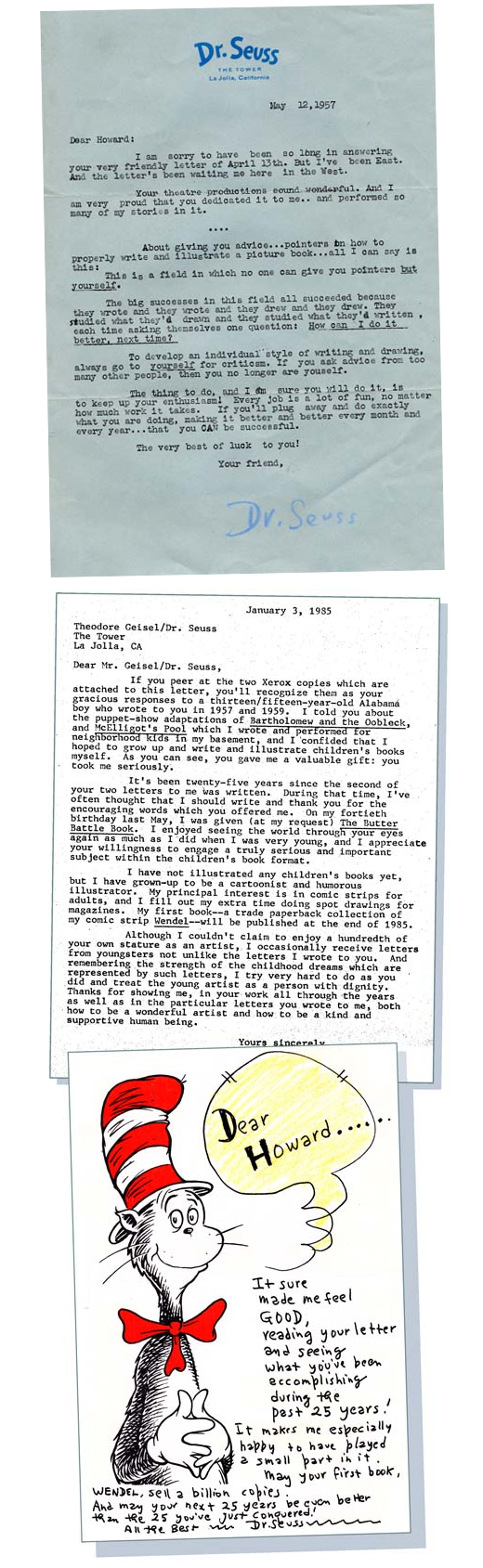
I have often thought that if I find success as an author, I shall get a P.O. box and put its address somewhere online or in my author bios and that I shall endeavor to respond to every handwritten letter that comes to me.
Maybe that's naive and romantic, but I still think it's an ideal worth striving towards.
Hopefully Letters of Note won't mind me reposting their images. Their website is silent on the issue.
Sunday, May 27, 2012
For the Locker: Neil Gaiman on Art
Not much more to say than that, really, other than that this speech is inspiring and interesting, and that the shots of the students remind me that I only graduated from college three years ago. I remember sitting in the audience, sleepless, terrified, and vaguely disappointed, vividly and viscerally. I do not remember a word of any of the speeches given.
Since then, somehow, I have done many enjoyable things. And I have a career that exists at least partly in the arts.
Sometimes I forget what an accomplishment that is.
Since then, somehow, I have done many enjoyable things. And I have a career that exists at least partly in the arts.
Sometimes I forget what an accomplishment that is.
Friday, May 18, 2012
Update
I am exhausted.
Last week I paddled (well, floated, mostly) down a river in Utah for 45 miles together with 10 other people. We drove four vehicles several hundred miles each way to do it. It was beautiful, but somehow that seems wrong to me.
Since getting back, I have been juggling reading a particularly vexing submission (These, for the record, are the ones that are great in some ways and not-so-great in others, leaving me to try to decide whether I think I can work with the author well enough to create a strong whole. They are not the bad ones. Bad ones are easy) with making up for taking several days off of doing paying work. And I have been looking for a new apartment. I have not been writing much at all.
Somehow a whole week has gone by. I will be gone for much of the next three weeks, with little hope of getting any writing done then, either.
But I have been here.
 And here.
 And I have been stealing moments of sleep to re-read Sandman, which feels somehow right and makes me happy.
These are good things, and I shall focus on them while the summer goes by and eventually, my life becomes cold and windy and calmer again in the fall.
Last week I paddled (well, floated, mostly) down a river in Utah for 45 miles together with 10 other people. We drove four vehicles several hundred miles each way to do it. It was beautiful, but somehow that seems wrong to me.
Since getting back, I have been juggling reading a particularly vexing submission (These, for the record, are the ones that are great in some ways and not-so-great in others, leaving me to try to decide whether I think I can work with the author well enough to create a strong whole. They are not the bad ones. Bad ones are easy) with making up for taking several days off of doing paying work. And I have been looking for a new apartment. I have not been writing much at all.
Somehow a whole week has gone by. I will be gone for much of the next three weeks, with little hope of getting any writing done then, either.
But I have been here.


These are good things, and I shall focus on them while the summer goes by and eventually, my life becomes cold and windy and calmer again in the fall.
Thursday, May 17, 2012
Bad Signs in Query Letters
The other week I was rolling through some submissions and noticed the following bad signs in query letters (details fudged to protect the guilty). None of them is enough to make me reject a submission alone, but they're indicative of likely problems in the writing to follow. If you find any of these items in your query, you may want to get a second opinion on your novel from a critical reader before submitting.
1.) "This book can be released as (insert number) books or as one." I want to know that you've thought hard about the structure of your novel and picked the best one for it. This does not convince me of that.
2.) Random punctuation. Learning where colons, commas, semicolons, and other marks go is part of your job.
3.) Boldface. If you don't trust me to find the important elements in your query on my own, how will you trust your reader to do it in your novel?
4.) Repetition ("Dripping with power and wealth, Malcolm has a lot of money and isn't afraid to use it."). Doesn't bode well for same in your novel.
5.) Excessive passive voice. I don't hate passive voice as much as most how-to-write books do, but it has a time and a place, and every sentence in the first paragraph of your query is not it.
6.) "My book is great because it's full of great characters who do great things and have great relationships." If you tell me this rather than show it to me, it bodes poorly for the show vs. tell ratio in your novel.
1.) "This book can be released as (insert number) books or as one." I want to know that you've thought hard about the structure of your novel and picked the best one for it. This does not convince me of that.
2.) Random punctuation. Learning where colons, commas, semicolons, and other marks go is part of your job.
3.) Boldface. If you don't trust me to find the important elements in your query on my own, how will you trust your reader to do it in your novel?
4.) Repetition ("Dripping with power and wealth, Malcolm has a lot of money and isn't afraid to use it."). Doesn't bode well for same in your novel.
5.) Excessive passive voice. I don't hate passive voice as much as most how-to-write books do, but it has a time and a place, and every sentence in the first paragraph of your query is not it.
6.) "My book is great because it's full of great characters who do great things and have great relationships." If you tell me this rather than show it to me, it bodes poorly for the show vs. tell ratio in your novel.
Subscribe to:
Posts (Atom)